Guide To Buying Acreage And Rural Homes Near Berthoud
May 21, 2026
May 21, 2026
Dreaming about a few acres near Berthoud? The wide views, extra space, and flexibility can be a huge draw, but rural property is not a plug-and-play purchase. If you are thinking about buying acreage or a rural home near Berthoud, you need to look beyond the house and understand the land, utilities, and access that come with it. This guide walks you through the key items to verify before you buy so you can move forward with more confidence. Let’s dive in.
Buying acreage near Berthoud is often more complex than buying in a typical neighborhood. With rural property, the parcel itself can shape what you can build, how water is used, whether septic records exist, and who maintains the road.
That is why acreage should be treated as a site-specific purchase. The exact location of the property, especially whether it is inside the Town of Berthoud or in unincorporated Larimer County, affects the rules that apply from the start.
Before you get too far into a listing, confirm whether the property is inside Berthoud town limits or in unincorporated Larimer County. Berthoud’s Development Code applies inside municipal boundaries, while Larimer County zoning rules apply in the unincorporated area.
That distinction matters because zoning, setbacks, accessory structures, and review processes can all differ based on jurisdiction. Both the town and the county provide map tools, and those should be checked early instead of relying only on a listing description.
Berthoud’s current Development Code took effect on December 10, 2025. Larimer County’s current Land Use Code page lists an effective date of December 8, 2025.
For you as a buyer, the takeaway is simple: current rules matter. If you hope to add a shop, expand the home, or adjust the property over time, you want to verify the parcel under the current code and not assume older information still applies.
In unincorporated Larimer County, rural zoning districts include Agriculture, RR-1, RR-2, Open, and related overlays. These districts can set rules for minimum lot size, setbacks, height, and accessory uses.
Larimer County also measures setbacks from the lot line or the road right-of-way or easement, whichever is greater. That means a lot that looks generous on paper may still have tighter buildable space than you expected.
For many rural buyers, water is one of the biggest diligence items. If a property uses a private well, you should confirm both the legal use of the well and the practical condition of the system.
In Colorado, every new well that diverts groundwater must have a permit. The permit file can include the allowed uses and available construction or pump records, which is important because the legal use of the well may not match the broad way a property is marketed.
Do not assume a well can support every use you have in mind. A permit may limit use to household purposes, or it may allow other uses such as irrigation or livestock depending on the permit.
If you want outdoor watering, animals, or other land-intensive uses, confirm those uses directly through the permit file. In many parts of Colorado, an augmentation plan may be required for certain uses such as lawn and garden irrigation, domestic animals, or a subdivision-type project.
Private wells are not regulated under the federal Safe Drinking Water Act, and the Colorado Department of Public Health and Environment states that individual well owners are primarily responsible for water safety. That makes water-quality testing an important step during your due diligence period.
Even if a home has been occupied for years, testing still matters. A well can be legally permitted and still need updated water-quality review, especially if you are trying to understand the property as a long-term home.
If a rural property is not connected to sewer, you also need to understand its septic system, called an onsite wastewater treatment system or OWTS. In Larimer County, a permit is required before building or repairing a septic system.
This becomes especially important if you plan to build new structures or change how the property is used. Larimer County states that a new system is needed for new construction or for extra buildings such as guest houses, garages, or barns when sewer is not available within 400 feet.
Larimer County allows septic documents to be viewed through the property records page. These records can help you confirm the existence of a permit, system details, and whether repairs or upgrades were completed.
However, older homes can be trickier. Homes built before 1973 often do not have permit records unless the system was repaired or upgraded later, so a missing record does not automatically mean the property has no septic system.
If you are considering new construction or a major change, Larimer County requires a soil test before applying for a septic permit. The application package also needs a soils report, design document, plot plan, and engineer’s design if needed.
If soil conditions are difficult, the county may require an engineer-designed system. That can affect both timeline and budget, so it is smart to ask those questions early.
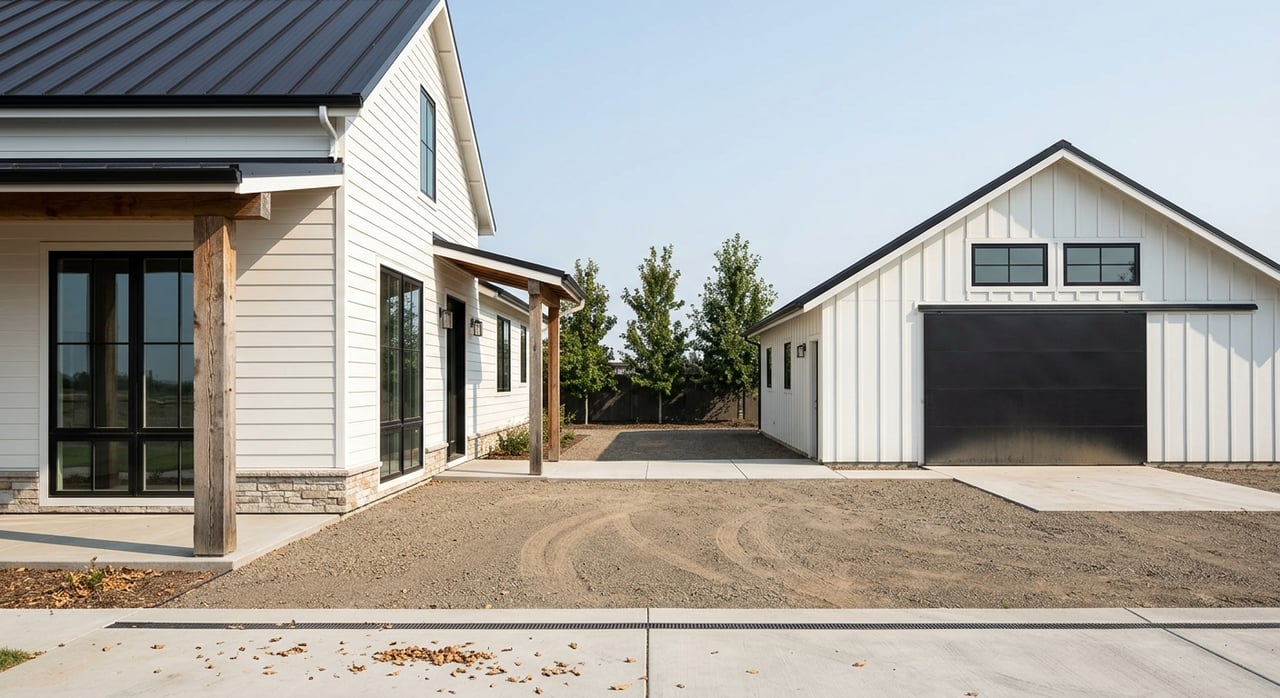
Acreage buyers often picture a barn, detached garage, workshop, or storage building. Those features can be a big part of the appeal, but they still need to fit local code.
In Larimer County, accessory uses and structures are secondary to the principal use. Under the current county code, the combined ground-floor area of all accessory structures may not exceed 10 percent of the lot’s net area, and accessory structures are generally not allowed until the principal use or structure is established unless the code says otherwise.
Some small non-habitable structures in Larimer County, such as a shed or playhouse under 200 square feet with no utilities, may be exempt from building permits. But that does not mean they are exempt from zoning and land-use rules.
Setbacks, lot coverage, and floodplain requirements may still apply. If you are buying with plans to add even a modest structure later, it is worth verifying what is actually allowed on that specific parcel.
If you are thinking about a guest house, expanded garage setup, or barn with additional utility needs, the analysis gets even more specific. Those plans may affect setbacks, permit requirements, and septic capacity.
For parcels inside Berthoud town limits, the town’s Development Code and review process apply instead of county zoning. Either way, it is best to verify proposed improvements with the appropriate planning and environmental health departments before making assumptions.
A beautiful property can feel very different after a snowstorm or spring runoff if access is limited. That is why road and driveway questions should be part of your early screening process, not an afterthought.
Larimer County is responsible for the construction, operation, maintenance, and improvement of public roads and bridges within the county. The county’s Road Information Locator can help identify who maintains a given road, which is especially useful when a property sits off a gravel lane or secondary route.
If the road is private, landowners are generally responsible for maintenance. In some subdivisions where the county has not accepted maintenance, residents or an HOA handle road upkeep, and county maintenance of subdivision roads is very limited.
That can affect both your budget and your expectations. A road may exist and still require shared upkeep, seasonal coordination, or extra planning during winter weather.
Even on county-maintained subdivision roads, the maintenance may be limited to work such as crack seal, chipseal, minor pothole repair, snow removal, sign maintenance, and some drainage maintenance. Reconstruction and resurfacing are typically not included.
Larimer County also notes that if a road system deteriorates enough, maintenance can be suspended until owners fund improvements needed to restore the road to a maintainable condition. For acreage buyers, that is an important practical detail.
When you tour rural homes near Berthoud, keep a simple access checklist in mind:
These issues can affect daily livability just as much as the home’s square footage or finishes.
The best way to evaluate acreage near Berthoud is to think of the property as a package. The house matters, but so do jurisdiction, zoning, water, septic, outbuildings, and access.
That is why the strongest rural buyers usually verify their intended use before they fall in love with the setting. If you want space for animals, outdoor watering, a future shop, or additional structures, those goals should shape your due diligence from day one.
Acreage purchases reward careful planning. When you understand the parcel first, you can avoid expensive surprises and focus on properties that truly fit your goals.
At Bison Real Estate Group, we help buyers look at the full picture across Larimer County, from the home itself to the practical details that can shape long-term use and enjoyment. If you are considering rural property near Berthoud, Bison Real Estate Group is here to help you navigate the process with local insight and clear communication.
Stay up to date on the latest real estate trends.

With a passion for real estate and a commitment to community betterment. We have consistently demonstrated exceptional expertise and dedication, earning recognition as one of America's Best Real Estate Professionals, ranking within the top 1.5% according to Real Trends.